Carnival Bands
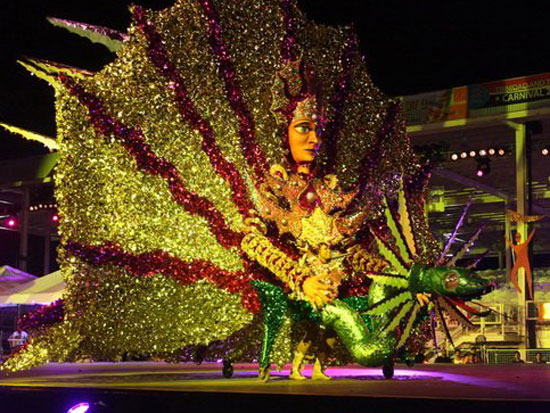
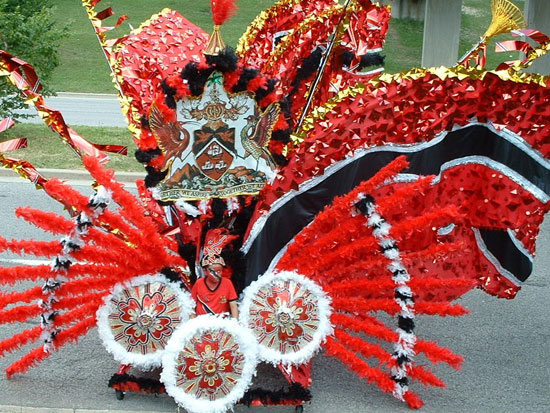
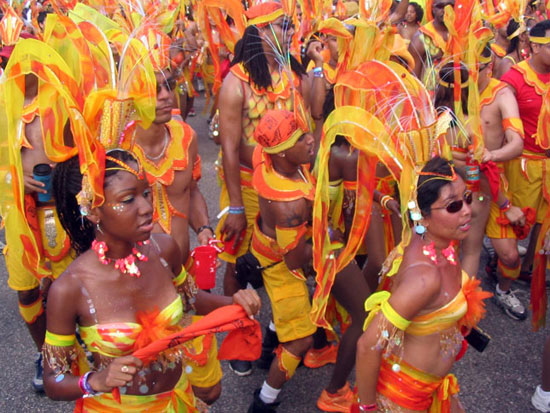
Carnival bands are organized groups made up of participants who pay for costumes fashioned by a designer and assembled by teams of volunteers.
Band leaders and designers begin working on their presentations months in advance of Carnival Monday and Tuesday. They usually hold a launch party the up to eight months before Carnival to showcase their costumes.
The costumed participants usually “play mas” as a group – band. Each band is led by a King and Queen, who wear extremely large costumes, often requiring extensions and wheels to assist the masquerader to carry it through the streets. Each year on Dimanche Gras (Carnival Sunday), a competition is held to award the King and Queen of Carnival title to two of these masqueraders.
On Carnival Monday and Tuesday, the bands are in competition to win the Band of the Year title. Small monetary prizes are associated with these titles, though they do not cover the full amount of producing the band's music or the King's or Queen's costumes. Children participate from as early as parents can get them into costume; sometime even strollers are decorated.
Children can extend their fun by participating in smaller "Kiddies' Carnival" shows, competitions and parades as early as 4 weeks before the culmination of the festival. For weeks ahead, several preliminary rounds of competitions and parties (or fêtes) take place.
As Carnival is part of the national curriculum, several programmes take place at schools across the country. Regional authorities handle smaller Carnival celebrations in smaller towns and villages.
Popular Carnival Characters
The Fancy Indian
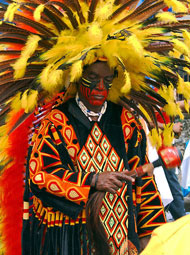
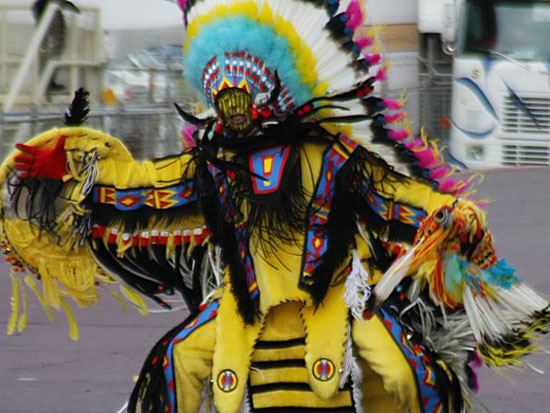
Fancy Indians are based on the indigenous peoples of North America. The wearer decides how expensive or expansive he wants this costume to be.
The headpiece in its simplest form, has grown over the years in splendour and size is worn with feathers sticking up, and more feathers making tails down the back. More elaborate headpieces are built over bamboo or wire frames supported by the masquerader's body. A masquerader's 'wigwam' is worked with ostrich plumes, mirrors, beads, feathers, papier mache masks, totem poles, canoes and ribbons. Bands of Indians can comprise a warrior chief and his family, a group of chiefs, or a group of warriors.
Island Butterfly








This costume is called The Spotted Flambeau Butterfly and depicts one of the most popular butterflies that are seen almost everywhere around the islands.
Hand-Painted silk chiffon…mounted on delicate and flexible rods…onto a backpack molded to the portrayers body…a suit painted onto the body for likeness…and then delicately, but heavily bejeweled at the neck and head with glass, crystal and jewels that mirror the shimmer of this elegant creature.
